
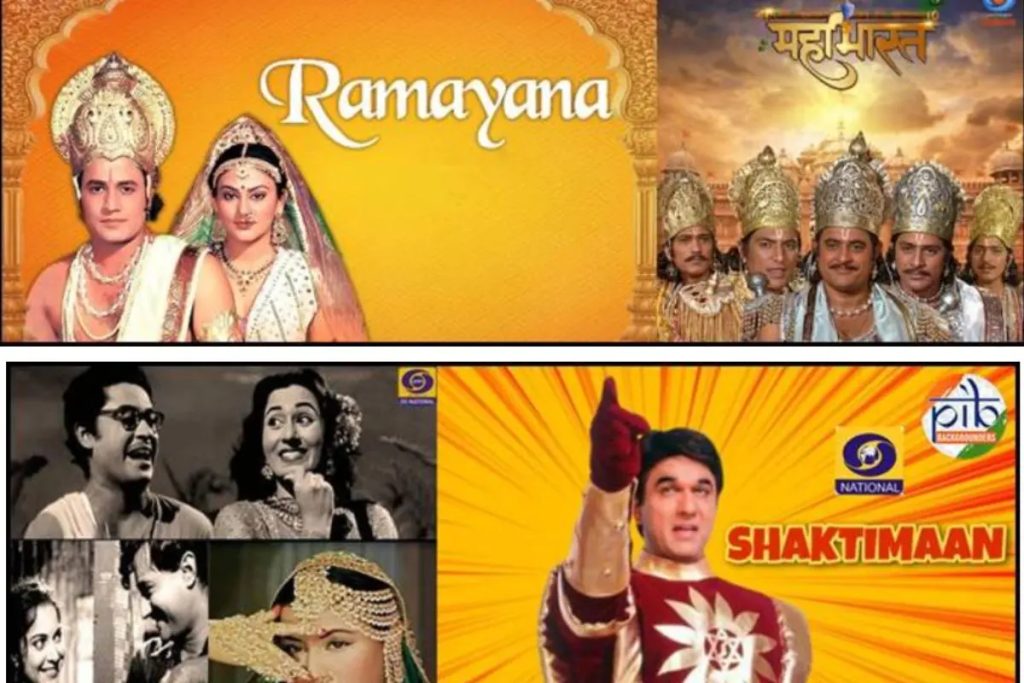
Let me take you back to the 1980s—a decade when Indian television was discovering its true potential and quietly shaping a cultural revolution. It was a time when entertainment was not merely consumed; it was experienced collectively. We are talking about the era of television serials that brought the entire nation to a standstill.
In those days, Doordarshan was the only television channel available. Entertainment options were limited, but whatever was broadcast had the power to unite millions. In 1982, the immensely popular program Chitrahaar became a household favourite. Featuring songs from Hindi films, it was aired in the evening when families gathered after a long day. Watching television was not an individual activity—it was a shared family ritual.
One of India’s earliest and most beloved serials, Hum Log, began airing in July 1984. Centered on a middle-class family, it ran for nearly 150 episodes and resonated deeply with viewers, who saw reflections of their own lives in its characters. This was followed by Buniyaad in 1986, a powerful drama based on the Partition of India and its aftermath. The serial touched emotional chords across generations.
Then came the historic moment in January 1987—Ramanand Sagar’s Ramayan. It was not merely a television show; it became a spiritual and cultural phenomenon. Every Sunday morning at 9:30 a.m., as the title music began, India seemed to pause. Streets wore a deserted look, shops remained closed, and public transport ran nearly empty.
The devotion of viewers was extraordinary. Many bathed before the telecast, performed prayers, and even garlanded their television sets. Arun Govil (as Lord Ram) and Deepika Chikhalia (as Mata Sita) were revered wherever they went, with people touching their feet in respect. They were seen as divine embodiments rather than actors. Arvind Trivedi, who portrayed Ravan, became so impactful that when his character died in the series, reports suggested an atmosphere of mourning in his home town.
Television sets were not common in every household then. Hundreds of people would gather around a single TV set in a neighborhood to watch each episode together. Important meetings were reportedly rescheduled to avoid telecast timings. Even minor power cuts during the broadcast could spark public outrage.
After Ramayan, B.R. Chopra’s Mahabharat aired between 1988 and 1990. Its iconic opening line, “Main Samay Hoon…” (“I am Time…”), still echoes in the memories of viewers. Mukesh Khanna as Bhishma Pitamah, Nitish Bharadwaj as Lord Krishna, and Puneet Issar as Duryodhan brought epic characters to life. Mahabharat was not just mythology—it explored ethics, politics, duty, power, and human relationships with remarkable depth. Dialogues from the show became part of everyday conversations, and families often discussed each episode long after it ended.
The impact of these serials was immense. Television set sales reportedly saw unprecedented growth during their broadcast years. More importantly, they created a shared national experience—millions of people watching the same story at the same time. It was a golden chapter in India’s social and cultural history.
Television in India had begun modestly in September 1959 in New Delhi, with limited hours of programming. Regular daily service started in 1965, expanding to Mumbai and Amritsar by 1972. The 1982 Asian Games marked the introduction of color television in India, paving the way for the television boom of the 1980s. Against this backdrop, Ramayan and Mahabharat defined what many now call the golden era of Indian television.
Today, we have hundreds of channels and countless OTT platforms. Content is abundant, but collective viewing has become rare. Back then, choices were limited, but emotional connection was profound. An entire nation would pause for a story, share the same emotions, and discuss the same episode.
That was not just entertainment—it was unity in storytelling. Perhaps that is why Ramayan and Mahabharat continue to hold a timeless place in India’s television history—when television was not merely a device, but a bond that connected families and the nation.
Author
The author is the founder of the Never Say Retire mission. In order to achieve this goal, he also runs this website and his Facebook group Never Say Retire Forum has Hundreds and Thousands of members today.